
Glow-up · face time-lapse · daily selfie
One selfie a day, and none of them jump.
A face time-lapse lives or dies on one thing: whether your eyes stay in the same place from frame to frame. Miss it and the video jitters. Hit it and a year of small changes plays like a single slow movement.
- Shoot
- Every day
- Projects
- 4
- Photos stay
- On your device
Cadence
Every day, and here is why.
Faces are the opposite of bodies. Skin, hair and beard change on a daily scale, and a daily photo is short enough to stay a habit. Miss a day and the reel barely notices.
The setup
Decide this once. Then stop deciding.
Every one of these is a decision you make a single time. The whole point is that the next photo needs no thought at all.
Use face mode, not the room
Face mode anchors to your face rather than what is behind you, so the photo lands the same whether you take it in your kitchen or a hotel room. This is the mode that makes travel days survivable.
Pick a light, not a place
Window light, indirect, at roughly the same hour. A face shot is mostly a lighting shot. Same window at 9am beats the same room at random times.
Neutral face, every time
Choose one expression and keep it. A smile in half the frames turns a glow-up reel into a flickering mess, because the whole lower face moves.
Eyes on the same line
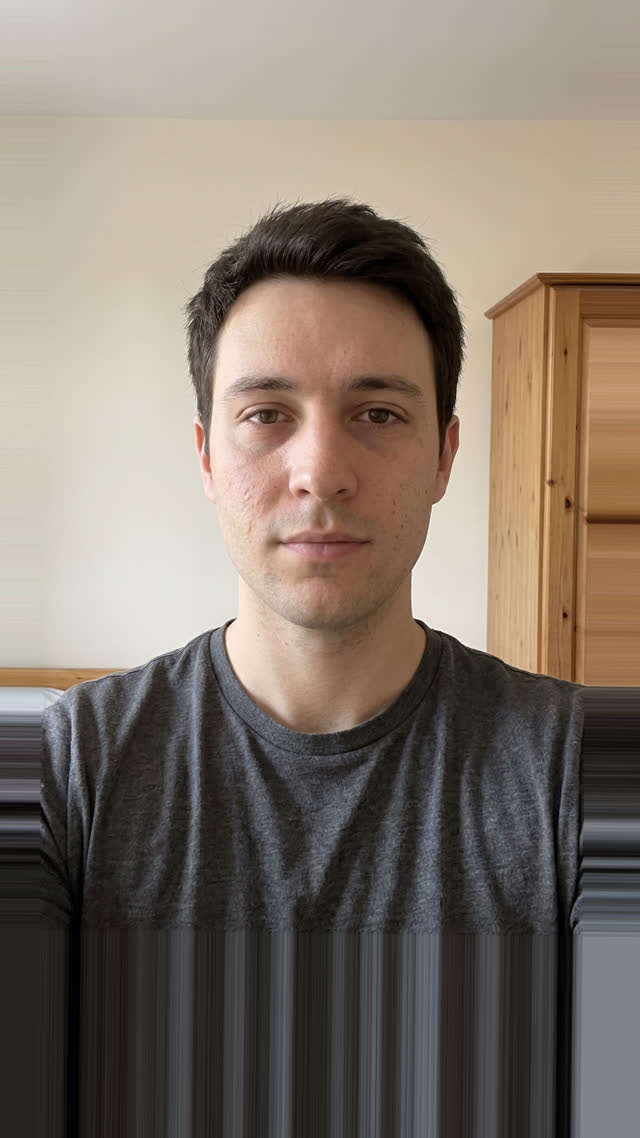
Line your eyes up with the ghost, not your chin or your hairline. Hair changes, jaws move with posture, but eye position is the axis the video rotates around.

The payoff
Two photos that agree on everything except the subject.
Drag it. The wall, the floor, the light and the lens are identical, so the only thing your eye can read is the change. That is the entire trick, and it is decided at capture time, not in an editor afterwards.
Try it with your own photosWhat goes wrong
The mistakes that quietly ruin the set.
- Switching between the front and rear camera. The lenses have different focal lengths, so your face changes shape mid-reel.
- Shooting under a ceiling light some days and a window on others.
- Holding the phone at arm’s length, which changes distance by ten centimetres every day.
- Skipping the boring middle. The middle is what makes the ends look dramatic.
Questions
Daily selfie photos, answered.
How do I make a daily selfie time-lapse?
Take one photo a day from the same distance, in the same light, with the same expression, and line each new shot up against the previous one. Then export the run of aligned photos as a vertical time-lapse. The alignment is what separates a smooth reel from a slideshow.
How long before a face time-lapse looks like anything?
Around thirty days reads as a real sequence, and ninety days is where most people first see a change they did not notice in the mirror. Hair and beard show sooner, skin takes longer.
What is face mode?
Face mode anchors the alignment to your face instead of the background, using on-device face detection. It means your daily selfie lands in the same place even when the room behind you is completely different.
Does the app upload my selfies?
No. There is no account and no server. Face detection runs on the phone itself and every photo stays in local storage on the device.
Also tracked with SameShot
Same camera, different subject.
Every day, or every other day
Beard growth
Day one stubble to a full beard, in one locked frame.
Every day, or every third day
Skin and acne
Routine tracking where the light cannot lie to you.
Weekly, or monthly for transplant recovery
Hair growth and transplant recovery
Hairline and regrowth shots the light cannot fake.
Guides & Tools
Related guides and tools for daily selfie progress.
Take the first one today.
The starting photo is the only one you can never go back and take. Free on Google Play, no account needed.

SameShot: Progress Photos
Appynox · Lifestyle
Before and after photos that line up. Ghost overlay camera, AI auto capture.
- Price
- Free
- Rated
- Everyone
- Account
- Not required
- iOS
- In development
Free, no account, nothing uploaded. Android 8.0 and above.